Popular Products


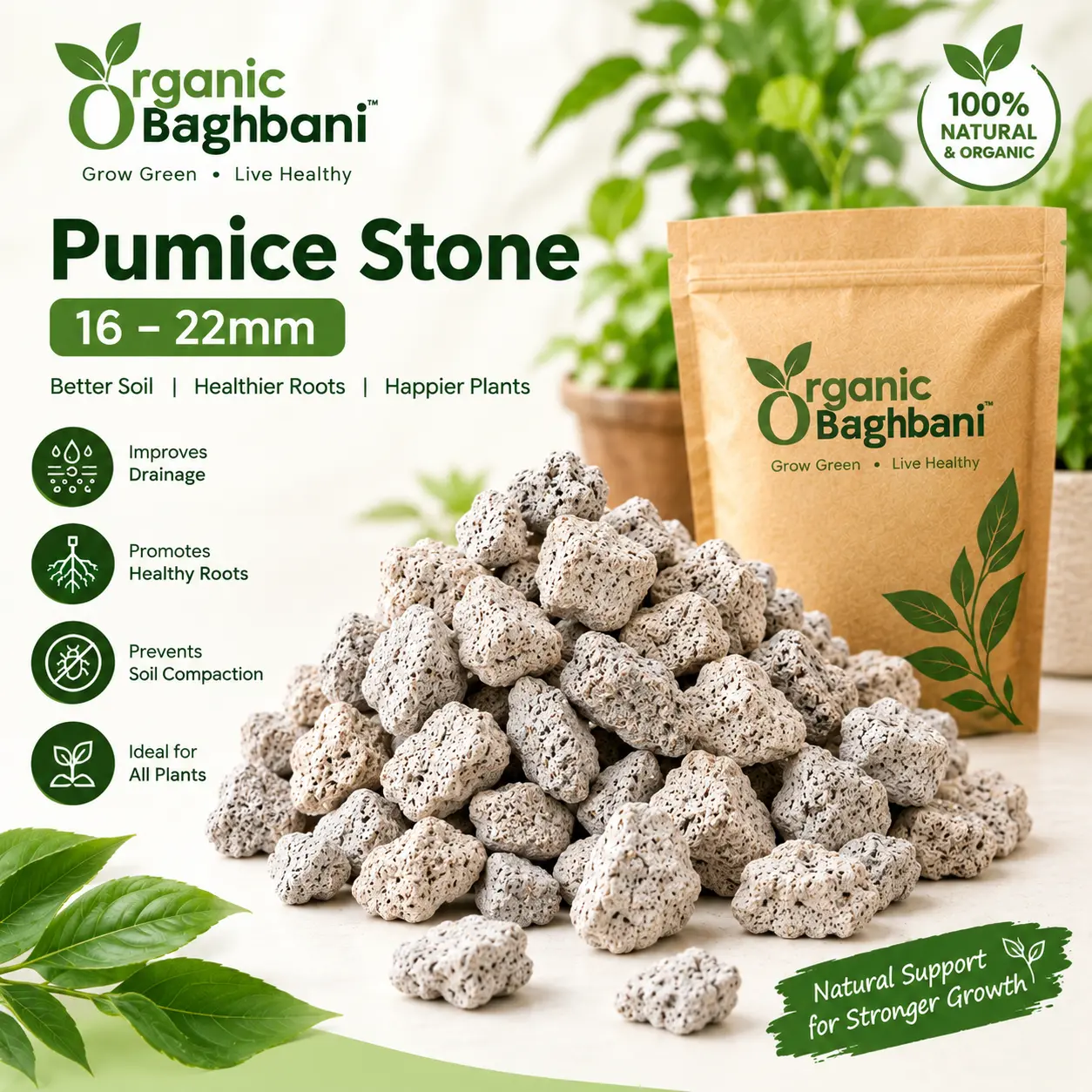
Organic Baghbani Coarse Pumice Stone 16–22mm is a large, natural volcanic pumice made for big pots, planters and chunky mixes. It opens up heavy soil, drains fast and lets roots breathe, and it is light enough for balcony and rooftop containers. It does not compact or rot, so your mix stays open season after season.
How Your Order Reaches You 🌿
Live step-by-step process from our store to your doorstep across Pakistan
Organic Baghbani 16–22mm is large pumice stone for plants. A coarse, natural volcanic aerator for big containers and chunky mixes. Its large, porous granules create wide air gaps that drain fast and keep roots oxygenated. Blend it into potting mix at roughly 15–40% by volume, depending on the plant, to prevent waterlogging, compaction and root rot in large pots, planters, orchids, aroids, large bonsai and fruit trees grown in containers. It is a mineral soil amendment, not a fertiliser, it adds no nutrients and does not break down.
Large containers hold a lot of soil, and heavy soil in them dries slowly. Garden mitti or coco peat in big drums, tubs and planters slowly compacts and can stay wet for days in humid monsoon weather, which leaves roots short of air. Large pumice granules keep wide air channels open all the way down, so water drains and the roots keep breathing.
| Plant | Why 16–22mm works | Starting mix (by volume) |
|---|---|---|
| Monstera, philodendron, alocasia and other large aroids | Chunky pieces give the airy, bark-like structure aerial-root plants prefer | About one-third pumice, one-third orchid bark, one-third potting mix |
| Orchids in bark mix | Adds stable, long-lasting aeration to bark | 20–30% pumice added to the bark mix |
| Large bonsai and pre-bonsai in big containers | Open, free-draining structure for thick roots | 20–40% pumice, the rest akadama or granular bonsai soil. Use 3–6mm or 7–14mm for small bonsai and upper layers |
| Fruit trees in large containers (citrus, guava, pomegranate, fig) | Opens up heavy soil in drums and big tubs to protect against root rot | 15–25% pumice in a soil and compost mix |
| Roses, bougainvillea and other large shrubs in planters | Keeps heavy garden soil airy | 15–25% pumice in a soil and compost mix |
| Large cactus, agave, big succulents and adenium | Gritty, fast-draining base for large specimens | 30–50% pumice, blended with a finer grade so the mix is not too chunky |
| Raised beds and planting holes in heavy clay | Helps loosen dense soil and improves aeration | 10–20% pumice blended through the planting mix |
These ratios are starting points. Adjust them for your climate, pot size and watering habit.
| Grade | Best for |
|---|---|
| Fine Pumice 3–6mm | Seedlings, cuttings, mini pots, small bonsai, upper layers |
| Coarse Pumice 7–14mm | Medium to large pots, bonsai, cactus, succulents, Monstera |
| Coarse Pumice 16–22mm | Large pots, planters, drums, raised beds, orchids, chunky mixes |
16–22mm is a large grade. Used alone in a small pot it makes a mix that is too chunky and dries too fast. For pots under roughly 25 cm (10 in), seedlings and cuttings, choose 3–6mm or 7–14mm instead. Many growers blend two grades in one mix: 16–22mm for structure and drainage, plus a finer grade to fill the gaps.
Pumice is a light, glassy volcanic rock formed when gas-rich lava cools quickly; the trapped gas bubbles leave a sponge like structure. In a pot, particle size controls the balance of air and water. Larger granules leave wider gaps between them, so water drains faster and more air reaches the roots, but the mix holds less water and dries sooner. That is why 16–22mm suits large pots and plants that dislike wet feet, while finer grades suit small pots and moisture-loving plants.
Pumice vs perlite: Pumice is heavier and harder, so it tends to stay mixed through the soil instead of floating to the surface when you water, and it holds its shape longer. Perlite is lighter.
Pumice vs gravel and lava rock: Gravel is heavy and holds little water. Lava rock is also porous but is usually heavier. Pumice is lighter, which matters for big planters, balconies and rooftops.
Feeding: Pumice holds very few nutrients itself, so plants in high-pumice mixes benefit from regular, dilute feeding. Pair it with Organic Baghbani organic fertilisers for a complete root-zone setup.
| Specification | Details |
|---|---|
| Product | Coarse Pumice Stone 16–22mm, large horticultural grade |
| Brand | Organic Baghbani |
| Material | Natural volcanic pumice |
| Particle size | 16–22 mm |
| Texture | Large, porous, lightweight granules |
| Nutrient content | None (inert mineral amendment) |
| Primary use | Soil aeration and drainage in large containers, chunky mixes, top dressing |
| Suitable for | Large pots and planters, orchids and aroids, large bonsai, fruit trees and roses in containers, raised beds |
| Not ideal for | Seedlings, cuttings, mini pots, small bonsai (use 3–6mm or 7–14mm) |
| Pack sizes | 1 kg, 2 kg, 5 kg, 10 kg, 25 kg |
| Origin | Pakistan/Asia |
| Bulk orders | Special discount on bulk quantity |
| Delivery | Across Pakistan in 2–4 working days; same-day in major cities |
Filling big planters, or buying for a nursery or landscaping job? Bulk quantities get a special discount – WhatsApp or call 03119073909. Organic Baghbani sources its products from certified dealers.
For pots of roughly 25 cm (10 in) and larger, drums, tubs and chunky mixes, 16–22mm works well. For medium pots, 7–14mm is usually a better fit, and for small pots and seedlings, 3–6mm.
It is not ideal. The granules are large for a small container, so the mix becomes too chunky and dries too fast. Choose 3–6mm or 7–14mm for small pots, or blend a little 16–22mm into a finer mix.
It depends on the plant. As a starting point, use 15–25% for fruit trees, roses and large shrubs, about a third for Monstera and aroids, 20–40% for large bonsai, 30–50% for large cactus and succulents, and 10–20% for raised beds. Increase the share if the mix stays wet too long.
Both are volcanic and improve aeration, but pumice is heavier and more durable, so it stays mixed through the soil and keeps its shape longer. Perlite is lighter and tends to float up.
No. Pumice is an inert mineral amendment and does not feed plants. Keep fertilising as usual, and a little more regularly in high-pumice mixes.
Multiply the planter volume by the share you want. For example, a 40-litre planter at 25% needs about 10 litres of pumice, which is roughly 5–7 kg depending on the batch.
Prices are shown per pack size on this page, with a special discount on bulk quantities. After you order we call to confirm, dispatch the same or the next day, and deliver in 2–4 working days across Pakistan, with same-day delivery in major cities.
People also search for: Pumice Stone 16-22mm, Pumice Stone 16-22mm Price in Pakistan, Best Mineral Amendments - Aeration & Drainage Additives for Gardening, Seed Starting & Potting Soil Mix.
At Organic Baghbani, we believe in nurturing nature the way it was meant to be. Our mission is to help Pakistani gardeners, farmers, and plant lovers grow healthier, greener plants without relying on harsh synthetic chemicals. All our organic fertilizers and soil amendments are carefully prepared to deliver maximum nutrients directly to your plants' roots.
Bring your garden back to life with 100% natural nutrition.
🌿 100% Natural & Safe: Completely free from toxic chemicals, making it safe for your family, pets, and the environment.
🌱 Improves Soil Health: Restores natural microbes in the soil, ensuring long-term fertility and explosive plant growth.
📦 Fast Nationwide Delivery: Secure and prompt shipping right to your doorstep, anywhere in Pakistan.
👨🌾 Premium Quality Guaranteed: Lab-tested and specifically suited for the harsh Pakistani climate.
No account yet?
Create an Account


Reviews
Clear filtersThere are no reviews yet.