Popular Products


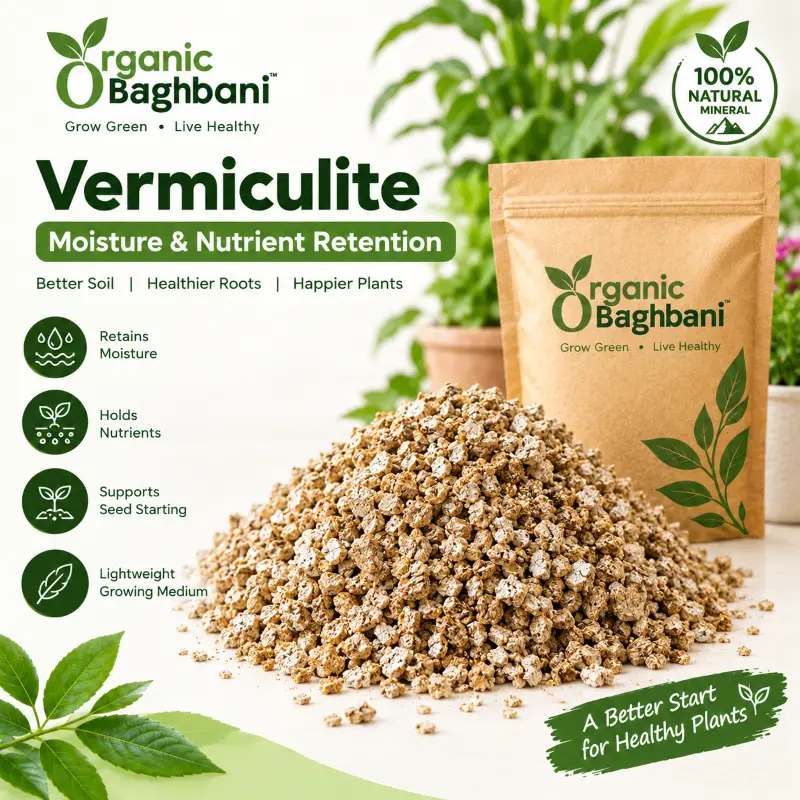
Organic Baghbani Horticultural Vermiculite is a lightweight, heat expanded mineral that holds water and nutrients in the root zone and keeps soil loose and airy. It is widely used for seed germination, cuttings, vegetable and herb pots and moisture loving plants, and it helps pots stay evenly moist through Pakistan’s hot summers. It retains moisture, so for cactus and succulents choose pumice instead.
How Your Order Reaches You 🌿
Live step-by-step process from our store to your doorstep across Pakistan
Organic Baghbani horticultural vermiculite is a lightweight, heat-expanded mineral that soaks up water and nutrients and releases them slowly to the roots. Mixed into potting soil, seed-starting mix or raised beds, it keeps the mix evenly moist, loosens dense soil and means you water less often. It is a mineral soil amendment, not a fertiliser, and it suits plants that like steady moisture, seedlings, cuttings, herbs, vegetables and ferns.
Pakistan’s hot, dry summers pull moisture out of small pots, hanging baskets and seed trays within hours. Seeds that dry out do not germinate, cuttings wilt before they root, and nutrients wash away with every watering. Vermiculite works like a mineral sponge: it holds water between its layers and holds nutrients too, so moisture and feed stay in the root zone for longer.
| Use | Starting mix (by volume) | Notes |
|---|---|---|
| Seed germination and seed starting | 1 part vermiculite to 1 part coco peat or compost, or a thin layer over sown seeds | Use a fine grade for small seeds; keep moist, not soggy |
| Cuttings | Vermiculite alone, or 1:1 with perlite | Moisten first, keep humid and out of harsh sun |
| Vegetables and herbs in pots (tomato, chilli, basil, mint, coriander) | 20–30% vermiculite in potting mix | Helps pots stay evenly moist in summer |
| Ferns, peace lily, calathea and other moisture-loving indoor plants | 20–30% vermiculite in potting mix | Reduces how often you water |
| Hanging baskets and small pots in hot weather | 20–30% vermiculite in potting mix | Small pots dry fastest |
| Heavy clay soil and raised beds | 10–20% vermiculite blended through the planting mix | Improves structure and moisture balance |
| Bulb and tuber storage (dahlia, canna, gladiolus) | Pack the bulbs in dry vermiculite | Store in a cool, dark, airy place |
These ratios are starting points. Adjust them for your climate, pot size and watering habit.
Vermiculite holds water, so it is the wrong amendment for cactus, succulents, adenium and other plants that need a fast-drying mix. For those, use pumice stone instead. Many growers keep both: vermiculite for seedlings and moisture-loving plants, pumice for free-draining ones.
Vermiculite and perlite are both heat-expanded minerals, but they do opposite jobs: vermiculite retains water and nutrients, while perlite drains. Pumice is the durable drainage choice and does not compress over time.
| Amendment | Main job | Water holding | Aeration | Best for |
|---|---|---|---|---|
| Vermiculite | Retains water and nutrients | Very high | Good | Seeds, cuttings, herbs, ferns |
| Perlite | Light aeration and drainage | Low | Excellent | Cuttings, lightening mixes |
| Pumice | Durable aeration and drainage | Moderate | Excellent, does not compress | Cactus, succulents, bonsai, aroids |
| Coco peat | Organic bulk that holds water | High | Moderate, can compact | Base for seed and potting mixes |
Vermiculite is a mica-like mineral made of thin layers with water trapped between them. When it is heated to a very high temperature, that water turns to steam and pops the flakes open into light, accordion-shaped granules, a process called exfoliation. The layers and tiny gaps hold water, while the mineral’s electrical charge (its cation exchange capacity) holds nutrients until roots need them. Because it holds so much water, vermiculite compresses slightly over time, so do not pack it down.
Only horticultural-grade vermiculite should be used for growing. Building and insulation grades can be coarser and are not meant for plants.
| Specification | Details |
|---|---|
| Product | Horticultural vermiculite (expanded) |
| Brand | Organic Baghbani |
| Material | Natural vermiculite mineral, heat-expanded |
| Grade | 2-6mm |
| Texture | Light, flaky granules; golden to brown, colour varies by batch |
| Water holding | High |
| Nutrient content | None added (holds nutrients through cation exchange) |
| Primary use | Moisture and nutrient retention, seed starting, cuttings, loosening heavy soil |
| Suitable for | Seeds, cuttings, vegetables, herbs, ferns, indoor foliage plants, hanging baskets |
| Not ideal for | Cactus, succulents, adenium, bonsai (use pumice) |
| Category | Soil Amendments & Mixes → Aeration & Drainage Additive |
| Pack sizes | 1 kg, 2 kg, 5 kg, 10 kg, 25 kg |
| Origin | Asia |
| Bulk orders | Special discount on bulk quantity |
| Delivery | Across Pakistan in 2–4 working days; same-day in major cities |
It is used to hold water and nutrients in the root zone. Gardeners add it to seed-starting mixes, cutting trays, vegetable and herb pots and moisture-loving plants, and use it to loosen heavy soil.
Yes. It holds steady moisture around the seed, is light enough for seedlings to push through, and is typically free of weed seeds. Use it alone, mix it 1:1 with coco peat or compost, or sprinkle a thin layer over sown seeds.
Vermiculite holds water and nutrients, while perlite mainly improves drainage and aeration. Use vermiculite where you want moisture retention and perlite where you want a faster-draining mix.
No. Vermiculite holds too much water for plants that need a fast-drying mix. Use pumice instead for cactus, succulents, adenium and bonsai.
About 20–30% of the mix suits most vegetables, herbs and moisture-loving indoor plants, and 10–20% suits heavy soil and raised beds. For seed starting, use up to half of the mix. Reduce the share if the mix stays wet for too long.
It holds and slowly releases nutrients through cation exchange and contains some natural potassium and magnesium, but it is not a fertiliser. Keep feeding your plants as usual.
Horticultural vermiculite is a natural mineral widely used in gardening. Like any fine mineral product it can create dust, so dampen it before use and avoid breathing dry dust. Use horticultural grade only, not building or insulation grade.
1 kg fills roughly 8–12 litres loosely, depending on the grade, so a 10-litre pot at 25% needs about 200–300 g. Prices are shown per pack size on this page, with a special discount on bulk quantities. After you order we call to confirm, dispatch the same or the next day, and deliver in 2–4 working days across Pakistan.
People also search for: Horticultural Vermiculite | Breathable Growth, Horticultural Vermiculite | Breathable Growth Price in Pakistan, Best Mineral Amendments - Aeration & Drainage Additives for Gardening, Seed Starting & Potting Soil Mix.
At Organic Baghbani, we believe in nurturing nature the way it was meant to be. Our mission is to help Pakistani gardeners, farmers, and plant lovers grow healthier, greener plants without relying on harsh synthetic chemicals. All our organic fertilizers and soil amendments are carefully prepared to deliver maximum nutrients directly to your plants' roots.
Bring your garden back to life with 100% natural nutrition.
🌿 100% Natural & Safe: Completely free from toxic chemicals, making it safe for your family, pets, and the environment.
🌱 Improves Soil Health: Restores natural microbes in the soil, ensuring long-term fertility and explosive plant growth.
📦 Fast Nationwide Delivery: Secure and prompt shipping right to your doorstep, anywhere in Pakistan.
👨🌾 Premium Quality Guaranteed: Lab-tested and specifically suited for the harsh Pakistani climate.
No account yet?
Create an Account


Reviews
Clear filtersThere are no reviews yet.