Popular Products


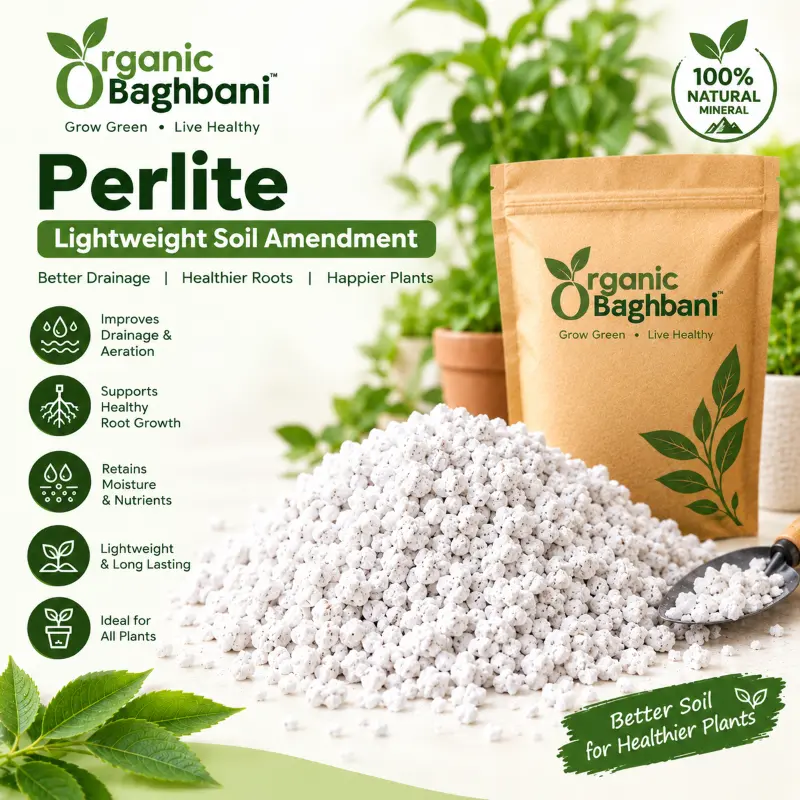
Organic Baghbani Horticultural Perlite is expanded volcanic glass, a white, ultra-light, porous granule that improves drainage and aeration in potting mix. It holds little water and no nutrients, so it keeps soil loose and fast-draining. It works best for cuttings, seed starting, succulents, houseplants, coco peat mixes and heavy garden soil.
How Your Order Reaches You 🌿
Live step-by-step process from our store to your doorstep across Pakistan
| Question | Answer |
|---|---|
| What is it? | Expanded volcanic glass, horticultural grade |
| What does it do? | Improves drainage and aeration in potting mix |
| How much water does it hold? | Low; water clings to the surface of the granules |
| Does it contain nutrients? | No, and it does not hold nutrients |
| What is it best for? | Cuttings, seed starting, succulents, houseplants, coco peat mixes, heavy soil |
| What is it not ideal for? | Plants that need steady moisture, if used alone |
| How much should I mix in? | Usually 10–40% of the mix by volume, depending on the plant |
| Use | Starting mix (by volume) | Notes |
|---|---|---|
| Perlite for cuttings (qalam): rose, hibiscus, coleus, pothos, money plant | Use alone, or 1:1 with vermiculite or coco peat | Moisten first, keep humid and out of harsh sun |
| Seed starting (beej) | 10–20% in a coco peat or compost-based seed mix | Use a fine grade |
| Succulents and cactus | 30–50% in well-draining potting mix | For mixes meant to last for years, pumice holds its place better |
| Houseplants (pothos, snake plant, rubber plant, ZZ) | 20–30% in potting mix | Helps if you tend to overwater |
| Monstera, philodendron and orchid mixes | 20–30% added to a bark-based mix | Use a coarse grade |
| Coco peat mixes | 20–30% blended into the coco peat | Stops it packing down and staying soggy |
| Vegetables and herbs in pots | 10–20% in potting mix | Add vermiculite as well for thirsty plants such as basil and mint |
| Heavy clay soil and raised beds (bhari mitti) | 10–20% blended through the planting mix | Opens up dense soil |
| Amendment | Main job | Water holding | Aeration | Best for |
|---|---|---|---|---|
| Perlite | Light aeration and drainage | Low | Excellent | Cuttings, seed mixes, coco peat mixes, lightening heavy soil |
| Vermiculite | Retains water and nutrients | Very high | Good | Seeds, cuttings, herbs, ferns |
| Pumice | Durable aeration and drainage | Moderate | Excellent, does not compress | Cactus, succulents, bonsai, aroids, long-term pots |
| Coco peat | Organic bulk that holds water | High | Moderate, can compact | Base for seed and potting mixes |
| Specification | Details |
|---|---|
| Product | Horticultural perlite (expanded) |
| Brand | Organic Baghbani |
| Material | Natural volcanic glass, heat-expanded |
| Grade | fine / medium / coarse |
| Appearance | White to off-white, lightweight, porous granules |
| Water holding | Low |
| Nutrient content | None; does not hold nutrients |
| Primary use | Drainage and aeration, rooting cuttings, seed mixes, loosening heavy soil |
| Suitable for | Cuttings, seedlings, succulents, houseplants, coco peat mixes, vegetables and herbs, raised beds |
| Not ideal for | Plants that need steady moisture, if used alone (add vermiculite or coco peat) |
| Category | Soil Amendments & Mixes → Aeration & Drainage Additive |
| Pack sizes | 1 kg, 2 kg, 5 kg, 10 kg, 25 kg |
| Origin | Aisa |
| Bulk orders | Special discount on bulk quantity |
| Delivery | Across Pakistan in 2–4 working days; same-day in major cities |
It improves drainage and aeration. Gardeners add it to potting mix, seed-starting mix, coco peat and heavy soil, and use it to root qalam (cuttings).
Yes. Houseplant pots often stay wet for too long, and the granules help the mix drain and stay open. About 20–30% of the mix is a sensible starting point for most houseplants.
Yes, at roughly 30–50% of a well-draining mix. For mixes you want to last for years, pumice is a better choice because it does not float up or break down as easily.
The white granules here improve drainage and aeration and hold little water, while vermiculite holds water and nutrients. Choose the first for a faster-draining mix and vermiculite for a more moisture-retentive one.
Pumice is heavier and more durable, so it stays mixed through the soil and suits long-term pots, bonsai and cactus. The lighter white granules suit cuttings, seed mixes and hanging baskets. See our pumice stone guide for sizes.
Usually 10–40% by volume: about 10–20% for vegetables and heavy soil, 20–30% for houseplants and coco peat mixes, and 30–50% for succulents. Increase the share if the mix stays wet for too long.
No nutrients. It is inert, so keep fertilising as usual. It is typically close to neutral in pH, so it does not change your mix much.
It is very light, so it rises when water flows through the pot. Dampen it before mixing, blend it into moist soil, and water slowly or from below.
It is a natural mineral widely used in gardening. Like any fine mineral product it can create dust, so dampen it before use and avoid breathing dry dust.
1 kg fills roughly 8–15 litres loosely, depending on the grade, so a 10-litre gamla at 25% needs about 2.5 litres, roughly 150–300 g. Prices are shown per pack size on this page, with a special discount on bulk quantities. After you order we call to confirm, dispatch the same or the next day, and deliver in 2–4 working days across Pakistan.
People also search for: Perlite, Perlite Price in Pakistan, Best Mineral Amendments - Aeration & Drainage Additives for Gardening, Seed Starting & Potting Soil Mix.
At Organic Baghbani, we believe in nurturing nature the way it was meant to be. Our mission is to help Pakistani gardeners, farmers, and plant lovers grow healthier, greener plants without relying on harsh synthetic chemicals. All our organic fertilizers and soil amendments are carefully prepared to deliver maximum nutrients directly to your plants' roots.
Bring your garden back to life with 100% natural nutrition.
🌿 100% Natural & Safe: Completely free from toxic chemicals, making it safe for your family, pets, and the environment.
🌱 Improves Soil Health: Restores natural microbes in the soil, ensuring long-term fertility and explosive plant growth.
📦 Fast Nationwide Delivery: Secure and prompt shipping right to your doorstep, anywhere in Pakistan.
👨🌾 Premium Quality Guaranteed: Lab-tested and specifically suited for the harsh Pakistani climate.
No account yet?
Create an Account


Reviews
Clear filtersThere are no reviews yet.