Popular Products


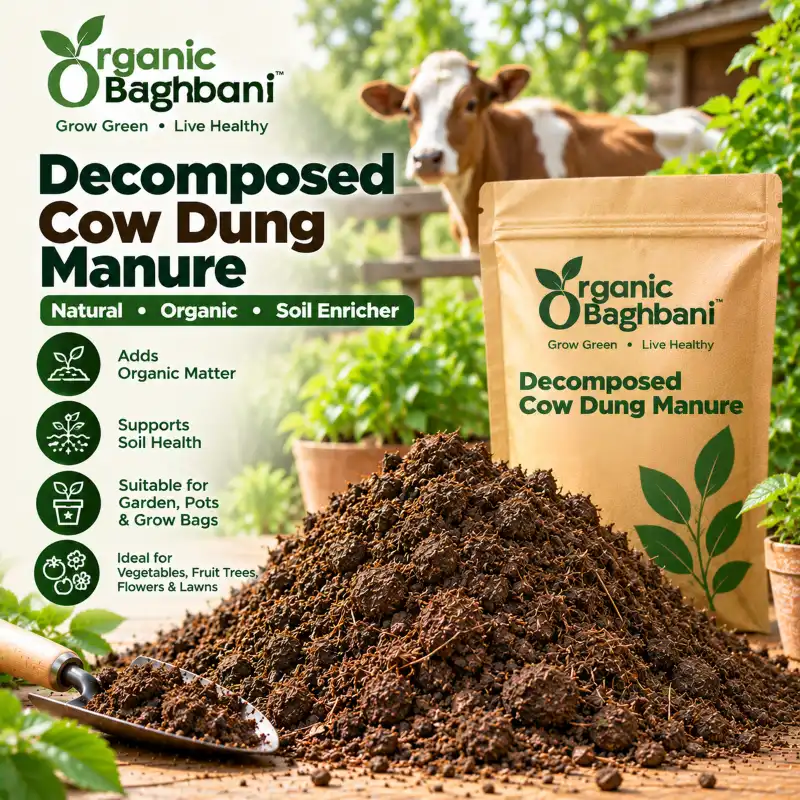
Our natural compost is made from cow dung (گوبر) that has been properly decomposed, with molasses added to take away the manure smell. It is a soil conditioner that adds organic matter to tired mitti (مٹی), feeds soil microbes and supports healthy roots (جڑیں) in vegetable beds, fruit trees, flowering plants and pots (گملے). It is not a seed-starting medium and not for cactus or succulents.
How Your Order Reaches You 🌿
Live step-by-step process from our store to your doorstep across Pakistan
Meaning of Cow Dung Compost in Urdu is “گائے کے گوبر کی کھاد” گائے کے گوبر کو اچھی طرح گلا سڑا کر بنائی گئی قدرتی کھاد. Ours Compost is completely natural: the dung is left to decompose fully, and a little molasses is added to take away the smell, so it is pleasant to handle and ready for the garden.
Cow dung is the plant residue that has passed through the animal’s gut, and it is naturally rich in minerals. Once it has broken down properly, it turns into a mellow, soil-ready material that gardeners have trusted for generations.
| Question | Answer |
|---|---|
| What is it? | Properly decomposed cow dung, with molasses added to remove the smell |
| What does it do? | Adds organic matter and minerals and feeds soil microbes |
| Product type | Decomposed cow dung, 100% natural |
| Best for | Vegetable beds, fruit trees, flowering plants, lawns and pots |
| Starting amount | About 1 part compost to 3–4 parts potting mix in pots; a 1–2.5 cm layer in beds |
| Not for | Sowing seeds directly into it, cactus and succulents |
| Made by | Natural product, supplied by Organic Baghbani, Pakistan |
| Look and feel | Dark brown to black, light, soft and crumbly, cool to the touch, with an earthy forest-soil smell |
Pakistan’s summer heat and repeated vegetable crops use up the organic matter in garden mitti quickly. Tired soil turns hard, holds less water and gives roots a poor start. Returning decomposed cow dung to the soil is one of the oldest and simplest ways to put that back.
Searching for cow dung fertilizer near me? Organic Baghbani supplies it directly, so you buy from a source you can ask questions. See the rest of our soil-building range in the Organic Fertilizers category.
Results depend on your soil, your plants and your watering.
| Use | Starting amount | Notes |
|---|---|---|
| Pots and grow bags (گملے) | 1 part compost to 3–4 parts potting soil mix (about 20–25%) | Blend well so the mix stays light |
| Vegetable and flower beds | 1–2.5 cm layer | Work into the top layer of soil before planting |
| Transplanting seedlings | Up to 20–30% of the mix | Do not sow seeds directly into it |
| Lawn (لان) top dressing | Very thin, about 5–6 mm | Rake in and water |
| Fruit trees and shrubs | About 2.5 cm ring around the drip line | Keep it off the trunk |
| Cactus and succulents | Not recommended | Use a gritty, fast-draining mix instead |
These are starting points, not rules. Begin on the lighter side and add more next season if the soil needs it.
| Product | Made from | Choose it when |
|---|---|---|
| Cow Manure compost | Decomposed cow dung with molasses | You want a simple, single-ingredient soil builder |
| Vermicompost | Cow dung processed by worms | You want a worm-processed feed for seedlings, herbs and houseplants |
| Organic compost | Decomposed leaves, food waste and manure, with molasses | You want a mixed, sieved everyday soil builder |
According to Wikipedia, cow dung is the undigested plant residue that passes through the animal’s gut, it is rich in minerals and it is often used as manure. Earthworms, dung beetles, fungi and other organisms break it down and recycle it into the soil, which is the same job decomposition does in a compost pile. Once it is fully decomposed and mixed into the soil, the organic matter feeds microbes, helps particles clump into crumbs so air and water move freely, and releases nutrients slowly.
| Specification | Details |
|---|---|
| Product | Decomposed cow dung with molasses |
| Brand | Organic Baghbani |
| Material | Cow dung (گوبر), properly decomposed |
| Additive | Molasses, added to remove the smell |
| Claim | 100% natural |
| Primary use | Soil enrichment and a component of potting mixes |
| Suitable for | Vegetables, fruit trees, shrubs, flowers, lawns, pots |
| Not ideal for | Direct seed sowing, cactus and succulents |
| Category | Organic Fertilizers |
| Origin | Pakistan |
| Bulk orders | Special discount on bulk quantity |
| Colour | Dark brown to black |
| Texture | Light, soft and crumbly; cool to the touch |
| Smell | Earthy, forest-soil smell; no raw ammonia or manure odor |
| Typical nutrients | Composted cow dung typically contains about 1–3% nitrogen (N), 1–2.7% phosphorus (P₂O₅) and 1–3.3% potassium (K₂O); general averages, not a lab test of each batch |
| Typical pH | Roughly 7.35–7.5, neutral to slightly alkaline; a general average, not a lab test |
| Pack Size | Effective Rate | Pack Price | Select |
|---|---|---|---|
1kg | ₨ 110 / KG | ₨ 110 | |
5kg | ₨ 80 / KG | ₨ 400 | |
20kg | ₨ 80 / KG | ₨ 1,600 |
People also search for: Cow Dung Compost, Cow Dung Compost Price in Pakistan, Best Composts & Manures for Gardening, Seed Starting & Potting Soil Mix.
At Organic Baghbani, we believe in nurturing nature the way it was meant to be. Our mission is to help Pakistani gardeners, farmers, and plant lovers grow healthier, greener plants without relying on harsh synthetic chemicals. All our organic fertilizers and soil amendments are carefully prepared to deliver maximum nutrients directly to your plants' roots.
Bring your garden back to life with 100% natural nutrition.
🌿 100% Natural & Safe: Completely free from toxic chemicals, making it safe for your family, pets, and the environment.
🌱 Improves Soil Health: Restores natural microbes in the soil, ensuring long-term fertility and explosive plant growth.
📦 Fast Nationwide Delivery: Secure and prompt shipping right to your doorstep, anywhere in Pakistan.
👨🌾 Premium Quality Guaranteed: Lab-tested and specifically suited for the harsh Pakistani climate.
No account yet?
Create an Account


Reviews
Clear filtersThere are no reviews yet.