Popular Products


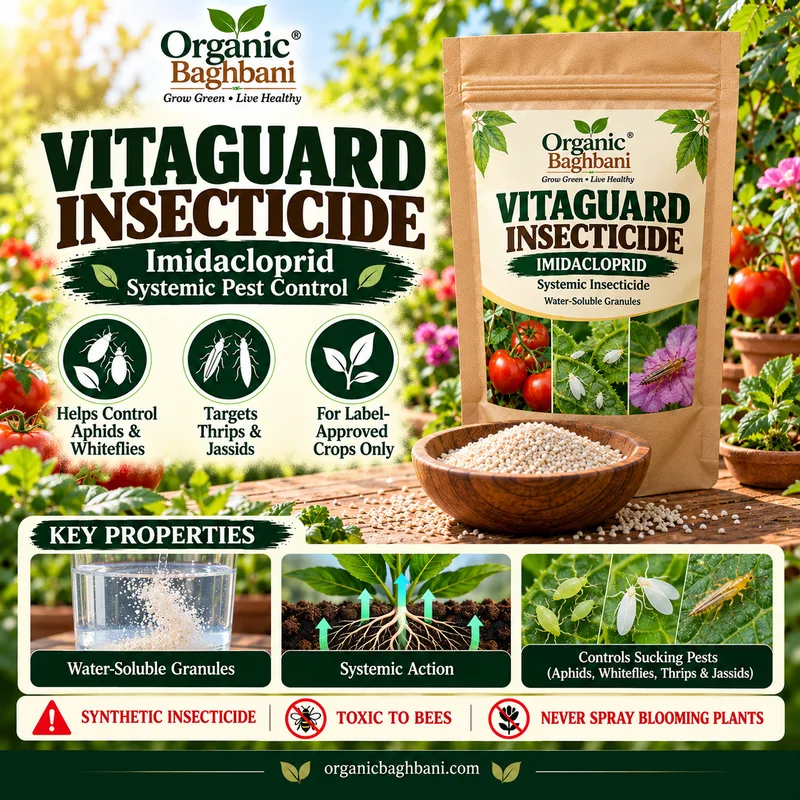
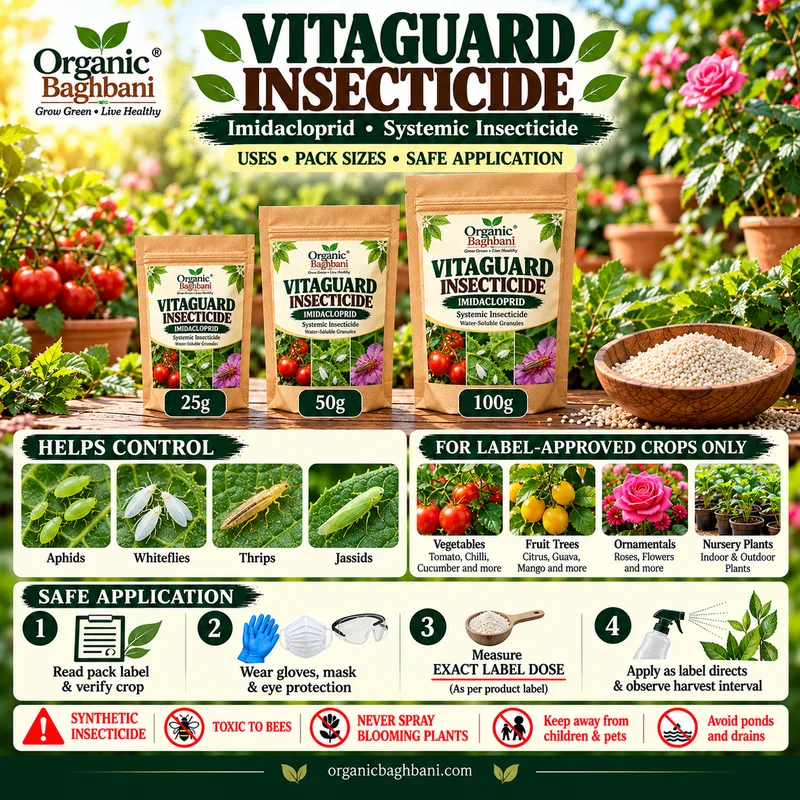
VitaGuard is a systemic neonicotinoid insecticide sold as water-soluble granules to help control sucking pests such as aphids (تیلا), whiteflies (سفید مکھی), thrips and jassids on vegetables, fruit trees and ornamentals. The plant absorbs it, so new growth can stay protected between sprays. It is a synthetic chemical, not an organic or plant-based product, and it is toxic to bees, so it must be used strictly as the pack label directs.
How Your Order Reaches You 🌿
Live step-by-step process from our store to your doorstep across Pakistan
Meaning of Imidacloprid Insecticide in Urdu is “امیڈاکلوپرڈ کیڑے مار دوا” ایک سسٹمک کیڑے مار دوا جو پودے کے اندر جذب ہو کر رس چوسنے والے کیڑوں سے بچاؤ میں مدد دیتی ہے۔ VitaGuard comes as water-soluble granules for gardeners and small growers who want a systemic option against sucking pests.
Imidacloprid belongs to the neonicotinoid family, which acts on the nervous system of insects. By blocking nicotinic acetylcholine receptors, it stops nerve signals passing between cells, which leads to paralysis and death of the insect. It binds much more strongly to insect receptors than to mammal receptors, but that does not make it harmless: it is a chemical insecticide, not an organic product, and it needs careful handling.
| Question | Answer |
|---|---|
| What is it? | VitaGuard, a neonicotinoid systemic insecticide supplied as water-soluble granules. |
| What does it do? | Helps control sucking pests such as aphids, whiteflies, thrips and jassids. |
| How does it protect? | The plant takes it up and moves it through its tissue, so new growth can be protected; it also acts when insects touch or feed on treated leaves. |
| How much should you use? | Only the dose printed on the pack label. Do not guess, double or “top up”. |
| Which sizes are available? | 10 g, 25 g, 50 g and 100 g. |
| Who is it for? | Home gardeners, nurseries and small growers with vegetables, fruit trees and ornamentals. |
| What is it not for? | Not organic, not for plants in flower that bees visit, not near ponds or drains, not for crops close to harvest, not for mites, and never for swallowing or for use around food. |
Sucking pests are among the hardest to stay ahead of in Pakistani gardens. Hot, dry weather and humid monsoon spells let whiteflies, aphids, thrips and jassids build up fast on okra, brinjal, chilli, roses and citrus. They weaken leaves, spread plant viruses and leave sticky honeydew, and plant-based sprays can struggle once a colony is large.
A systemic product works from inside the plant, which helps reach pests that hide on leaf undersides and new growth. It is a stronger tool than a leaf rinse, so it comes with stricter rules, which this page spells out.
If you have been searching for imidacloprid near me, you can order it from Organic Baghbani and browse our wider Insecticides & Pest Repellents range.
Results depend on the pest, your plants, the dose you use and the weather.
Imidacloprid is an agricultural chemical with real risks. Read these points before you order.
Imidacloprid is acutely toxic to honeybees and can harm bumblebees and other pollinators. Wikipedia notes that the European Union has banned all outdoor use of the main neonicotinoids since 2018, and the US EPA lists its own actions to protect pollinators. So never spray plants in flower, avoid flowering weeds underneath, and do not treat plants that bees are visiting. It is also toxic to some birds and to aquatic invertebrates, so do not leave spilled granules or spray near ponds, canals or drains.
It is rated moderately toxic if swallowed. Swallowing can cause vomiting, sweating, drowsiness and disorientation. Wear gloves, a mask and long sleeves when mixing and spraying, wash your hands and clothes afterwards, and keep the packs and the freshly sprayed area away from children, pets and food. If it is swallowed or gets in the eyes, get medical help at once and show the label.
Follow the waiting period before harvest printed on the label, and wash produce well. Do not spray close to harvest. If the label does not list your crop, do not use it on that crop; message us on WhatsApp 03119073909 first.
We do not print a dose here, because the correct amount depends on the strength of the granules and on the crop, and it must come from the pack label. Using too much does not make it work better; it raises the risk for bees, people and your harvest.
| Use | Typical pests | Notes |
|---|---|---|
| Vegetables listed on the label (okra, brinjal, chilli, tomato) | Whiteflies, aphids, thrips, jassids | Check the label for the crop and the waiting period. |
| Fruit trees such as citrus and guava | Aphids, thrips and other sucking pests | Avoid spraying during flowering. |
| Ornamentals and roses | Aphids, thrips, whiteflies | Spray only when blooms are closed or removed. |
| Nurseries and seedlings | Whiteflies, aphids | Test a few plants first and use the label dose. |
| Termite problems | Termites | This needs a specific label method and dose. Message us before buying. |
Because the dose is in grams, work it out yourself: divide the pack size by the label dose per litre to see how many litres it makes. As a rule, 10 g and 25 g suit a balcony, a few pots or a first trial, while 50 g and 100 g suit a kitchen garden, a nursery or a small orchard. Use a small digital scale for accuracy, not a spoon.
| Option | What it is | How it works | Watch out |
|---|---|---|---|
| VitaGuard (imidacloprid) | Synthetic systemic insecticide | Taken up by the plant; acts on feeding insects | Toxic to bees; follow waiting periods and the label |
| Plant-based neem sprays | Neem oil leaf sprays from our Insecticides & Pest Repellents range | Repel and discourage feeding | Slower, need repeat sprays, weaker on heavy infestations |
| Neem cake | Neem seed solids, a granular organic fertiliser | Worked into the soil | Feeds soil; it is not a quick pest fix |
| Hand-picking or a water jet | No product | Removes pests physically | Labour-heavy on large plants |
If you garden organically, grow food for children or keep bees nearby, a plant-based spray is usually the better first step. Choose VitaGuard when sucking pests are heavy and gentler options have not been enough.
Imidacloprid is a systemic insecticide in the neonicotinoid group (IRAC group 4A). It moves easily in the plant’s xylem from the soil into the leaves and also penetrates leaf tissue, according to Wikipedia’s imidacloprid article. Insects that touch or feed on treated tissue have their nerve signals blocked, which paralyses them.
Repeated use of one chemical group can lead to resistant pests, so rotate with products from different groups and mix in non-chemical steps such as removing infested leaves. Imidacloprid also persists in soil for a long time, which is another reason to use only the label dose.
| Pack Size | Effective Rate | Pack Price | Select |
|---|---|---|---|
25gm | ₨ 8,000 / KG | ₨ 200 | |
50gm | ₨ 7,000 / KG | ₨ 350 | |
100gm | ₨ 6,000 / KG | ₨ 600 |
People also search for: VitaGuard Insecticide, VitaGuard Insecticide Price in Pakistan, Best Insecticides & Pest Repellents for Gardening, Seed Starting & Potting Soil Mix.
At Organic Baghbani, we believe in nurturing nature the way it was meant to be. Our mission is to help Pakistani gardeners, farmers, and plant lovers grow healthier, greener plants without relying on harsh synthetic chemicals. All our organic fertilizers and soil amendments are carefully prepared to deliver maximum nutrients directly to your plants' roots.
Bring your garden back to life with 100% natural nutrition.
🌿 100% Natural & Safe: Completely free from toxic chemicals, making it safe for your family, pets, and the environment.
🌱 Improves Soil Health: Restores natural microbes in the soil, ensuring long-term fertility and explosive plant growth.
📦 Fast Nationwide Delivery: Secure and prompt shipping right to your doorstep, anywhere in Pakistan.
👨🌾 Premium Quality Guaranteed: Lab-tested and specifically suited for the harsh Pakistani climate.
No account yet?
Create an Account


Reviews
Clear filtersThere are no reviews yet.