
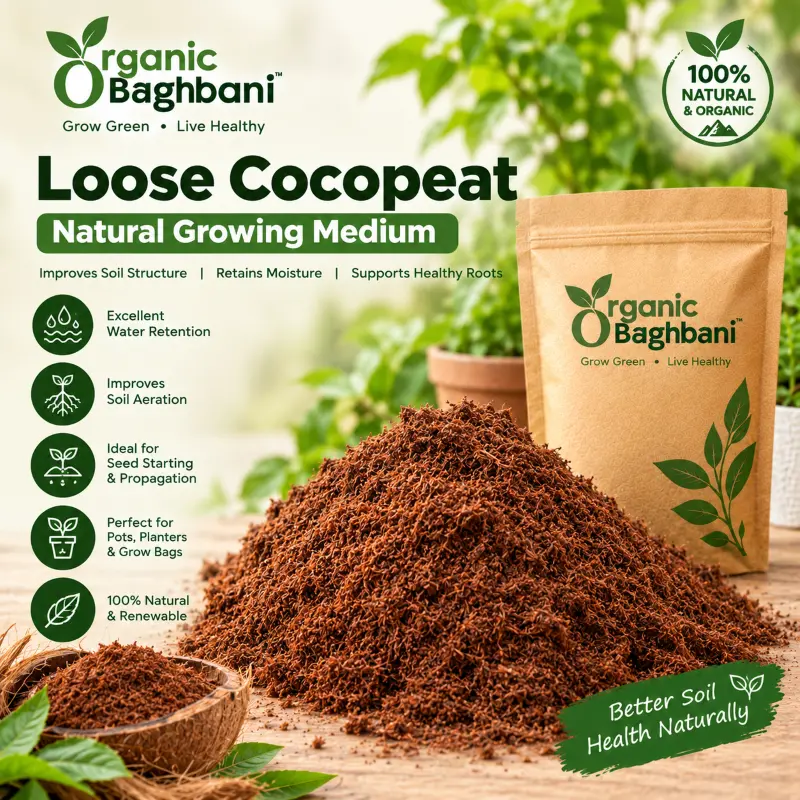
What Is Cocopeat? (کوکو پیٹ کیا ہے؟)
Organic Baghbani loose cocopeat is cocopeat for plants in its simplest form: the fine, spongy, reddish-brown pith (also called coir pith, coco coir or coir dust) that remains after the long fibres are removed from coconut husk. It is sold loose and fluffy, ready to be moistened and mixed, instead of as a hard compressed brick. It holds a lot of water and air at the same time, it is a renewable alternative to peat moss, and it carries very few nutrients of its own, so you stay in control of feeding.At a Glance
| Question | Answer |
|---|---|
| What is it? | Coconut coir pith, sold loose (not compressed) |
| What does it do? | Holds water and air in potting mix and seed trays |
| How much water does it hold? | Very high, roughly 6–8 times its own weight |
| What is its pH? | Typically about 5.5–6.5 [confirm for your batch] |
| Does it contain nutrients? | Very few; plants need regular feeding |
| What is it best for? | Potting mix, seed starting, cuttings, hanging baskets, raised beds, worm bedding |
| What is it not ideal for? | Cactus and succulents on its own |
| How much should I use? | 30–50% of a potting mix, or more for seed trays |
Why Do Gardeners Choose Cocopeat?
Garden mitti bakes hard in Pakistan’s summer heat, turns heavy and soggy in the monsoon, and cracks away from the sides of the pot. Sandy mixes dry out in a day. A soft, fibrous medium that soaks up water and releases it slowly keeps roots evenly moist without drowning them, and it is far lighter to carry up to a balcony or terrace. Peat moss does a similar job but is mined and less sustainable, which is why many growers now switch to coconut coir.What Does It Do for Your Plants?
- Holds water: it can hold six to eight times its own weight, which means fewer waterings and a steadier supply for roots.
- Keeps air in the mix: its fibrous structure is highly porous, so roots can breathe, and it settles less than many other media.
- Rewets easily: unlike dry peat moss, it takes up water again without a wetting agent.
- Suits most plants: the pH is usually close to neutral to slightly acidic, so it needs little or no lime.
- Lightweight (ہلکا): it lowers pot weight, which helps with hanging baskets, balconies and rooftop gardens.
- Slow to break down: coir is rich in lignin, so it does not rot quickly and keeps its structure through the season.
- Renewable and reusable: it is a by-product of the coconut industry, and it can often be reused for another season if the plants were healthy.
Cocopeat for Plants: Where to Use It and How Much to Add
| Use | Starting mix (by volume) | Notes |
|---|---|---|
| Houseplants and patio plants | 30–50% cocopeat, the rest compost, garden soil and perlite | Add perlite or pumice for drainage |
| Vegetables and herbs in pots or grow bags | 30–50% | Keeps pots moist in hot weather; mix with compost |
| Seed starting (cocopeat for seeds) and cuttings | 50–100% fine cocopeat, or 1:1 with vermiculite or perlite | Keep moist, not soggy |
| Hanging baskets and small pots | 40–60% | Light, and saves watering |
| Raised beds and heavy or sandy soil | 10–20% mixed in | Loosens clay and helps sandy soil hold water |
| Orchids, aroids and chunky mixes | 10–20% with bark and pumice | Use sparingly |
| Cactus, succulents and bonsai | Avoid, or use only 10–20% with pumice | It holds too much water for them |
| Worm bins (کیچوے bedding) | Damp bedding, mixed with shredded cardboard | A good home for red wiggler worms |
| Mulch | A thin layer around plants | Slows evaporation from the soil |
Is It Washed, Low-EC or Buffered?
Coconuts often grow in salty conditions, so raw coir pith can carry sodium, potassium and chloride that stress young roots. Good quality cocopeat is washed to remove most of those salts, and some is also buffered with calcium nitrate to make it more stable. This cocopeat is [confirm: washed / buffered, with the measured EC if you have it]. If you are growing sensitive seedlings, rinse it once with clean water and let it drain before use.Cocopeat vs Peat Moss vs Perlite vs Vermiculite vs Rice Husk
Cocopeat holds water and air, so most gardeners blend it with something that drains. Perlite, pumice and rice husk add drainage and long-lasting air space, while vermiculite adds more water and nutrient holding.| Material | Main job | Water holding | Aeration | Notes |
|---|---|---|---|---|
| Cocopeat | Water and air in one light medium | Very high | Good | Renewable; pH about 5.5–6.5; rewets easily |
| Peat moss | Water holding | Very high | Good | Mined; more acidic; hard to rewet when dry |
| Perlite | Drainage and aeration | Low | Excellent | Lightweight, does not break down |
| Vermiculite | Water and nutrient holding | Very high | Good | Best for seeds and cuttings |
| Rice husk | Aeration, mulch | Low | Good | Organic; breaks down slowly |
How Does It Work in the Soil?
Coir pith is made of tiny, lignin-rich particles full of microscopic pores. Water is held inside and between those particles like a sponge, while the larger gaps hold air, which is why a coir-based mix usually keeps roughly a fifth of its volume as air even when it is well watered. The pith also has a cation exchange capacity, meaning it can hold on to nutrients and release them to roots. Because lignin resists decomposition, it breaks down slowly, so it keeps its structure far longer than compost or garden soil.How Do You Use It?
Using cocopeat for potting mix is simple:- Moisten it gradually, adding water and stirring until it feels like a wrung-out sponge. If it is very dusty, dampen it first.
- Rinse it once with clean water and drain it if you are starting seeds or growing sensitive plants.
- Blend it with perlite, pumice, compost or garden soil, using the table above.
- Fill the pot, plant, and water gently.
- Water less often than you would in garden soil, and check the mix with a finger before watering.
- Feed regularly with dilute fertiliser or compost (کھاد), because coir holds very few nutrients of its own.
- Store the bag dry and closed.
Product Specifications
| Specification | Details |
|---|---|
| Product | Loose cocopeat (coconut coir pith), dry |
| Brand | Organic Baghbani |
| Material | Coconut coir pith |
| Form | Loose, fluffy, not compressed |
| Particle size | medium |
| Treatment | Washed |
| pH | Typically about 5.5–6.5 [confirm for your batch] |
| Water holding | Very high, about 6–8 times its weight |
| Nutrient content | Very low |
| Primary use | Potting mix base, seed starting, moisture retention, worm bedding, mulch |
| Suitable for | Houseplants, vegetables, herbs, seedlings, hanging baskets, raised beds |
| Not ideal for | Cactus and succulents on their own |
| Category | Soil Amendments & Mixes → Growing Media & Peat |
| Pack sizes | 1 kg, 2 kg, 5 kg, 10 kg, 25 kg |
| Origin | Pakistan |
| Bulk orders | Special discount on bulk quantity |
| Delivery | Across Pakistan in 2–4 working days; same-day in major cities |
How Do You Order Cocopeat in Pakistan? (آرڈر کیسے کریں؟)
- Select your pack size and add it to the cart.
- We call you to confirm the order.
- Your parcel is packed and dispatched the same day or the next day.
- It reaches you in 2–4 working days across Pakistan, and same-day delivery is available in major cities through our dealer network.
FAQ
What is it used for? (کوکو پیٹ کس کام آتا ہے؟)
It is used as a light, water-holding base for potting mix, seed trays, cuttings, hanging baskets and raised beds, and as bedding for worm bins. Many gardeners use it in place of peat moss.
Is it good for plants? (کیا یہ پودوں کے لیے اچھا ہے؟)
Yes. It holds water and air, suits most plants, and keeps its structure for a long time. It adds very few nutrients, so feed your plants regularly.
Do I need to wash or soak it first?
Moisten it before use. If it is washed or buffered grade, it is ready after wetting; for seeds and sensitive seedlings, a single rinse with clean water is a cheap extra precaution.
Can I use it alone, without soil?
Yes, with regular watering and feeding, as many hydroponic-style growers do. For most home gardens, blending it with perlite, pumice or compost gives better drainage and nutrition.
How much should I mix into potting soil?
About 30–50% for most houseplants and vegetables, 50–100% for seed trays, and 10–20% for raised beds and heavy soil. Use less for plants that like dry roots.
What is the difference between cocopeat and peat moss?
Both hold water and air. Cocopeat is renewable, has a higher pH and rewets easily, while peat moss is mined, more acidic and hard to rewet once dry.
Can I use it for cactus and succulents?
Not on its own, because it holds too much water for them. Use mostly pumice and only a small share of cocopeat, if any.
Can I reuse it?
Often yes, for another season, if the plants in it were healthy. Mix in some fresh material and compost, and do not reuse it after diseased plants.
How much do I need, and what is the cocopeat price in Pakistan? (قیمت کیا ہے؟)
1 kg of loose cocopeat fills roughly 8–12 litres once moistened, depending on the grade, so a 10-litre pot at 40% needs about 4 litres, roughly 350–500 g. Prices ₨ 220/kg are shown per pack size on this page, with a special discount on bulk quantities. After you order we call to confirm, dispatch the same or the next day, and deliver in 2–4 working days across Pakistan.
People also search for: Organic Baghbani Loose Cocopeat, Organic Baghbani Loose Cocopeat Price in Pakistan, Best Growing Media & Peat for Gardening, Seed Starting & Potting Soil Mix.
Related Growing Media & Peat Links
- View Full Category: Growing Media & Peat Collection

Reviews
Clear filtersThere are no reviews yet.