
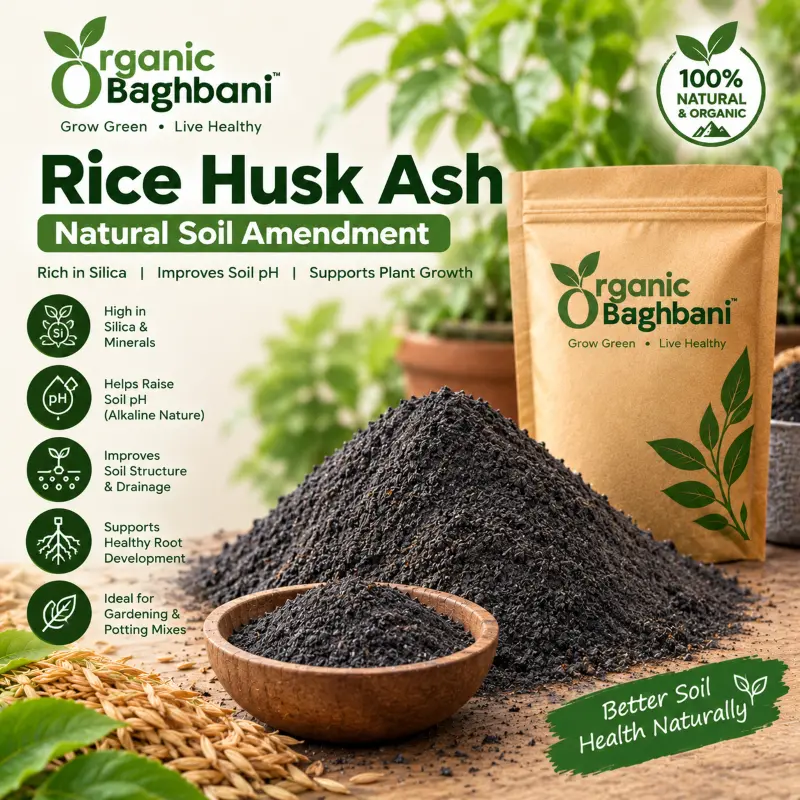
What Is Rice Husk Ash? (چاول کے چھلکے کی راکھ کیا ہے؟)
Organic Baghbani sells rice husk ash for plants as a clean, fine, ready-to-use black powder: the ash that remains when rice husk is burnt in a controlled environment and only partly, made up of silica with a good share of potassium and trace minerals, plus some leftover porous carbon. In the garden it is a soil conditioner. It adds minerals, gently lifts the pH of acidic mixes and keeps soil open, but it is not a complete fertiliser, because most of the nitrogen burns off when the husk is burnt.At a Glance
| Question | Answer |
|---|---|
| What is it? | Black, partly carbonised ash from burnt rice husk |
| What does it do? | Adds potassium, silica and trace minerals; buffers acidic soil; loosens mixes |
| What is it rich in? | Silica and potassium, plus some porous carbon |
| Does it contain nitrogen? | Very little |
| What is its pH? | Mildly alkaline, about 8–9, varies by batch |
| What is it best for? | Coco peat and compost-based mixes, vegetable beds, container plants, compost |
| What is it not for? | Acid-loving plants, seed starting, soil that is already alkaline, worm bins |
| How much should I use? | 5–10% of a potting mix, or about 100–250 g per m² of bed |
Why Add Ash to Your Soil?
Coco peat, peat moss and compost-heavy mixes can run slightly acidic and short on potassium and trace minerals, and heavy watering washes nutrients out of pots. A small amount of mineral ash tops up those minerals and calms the acidity at the same time. For anyone who prefers natural, recycled inputs, it also turns a rice-mill by-product into something useful for the garden.What Does It Do for Your Plants?
- Natural potassium source: potassium (پوٹاشیم) supports flowering, fruiting and water balance, which fruiting vegetables such as tomato and chilli appreciate.
- Silica: rice husk is one of the richest plant sources of silicon, which plants take up in small amounts. Benefits vary with the crop and the soil.
- Mild liming effect: the alkaline ash buffers acidic soil and mixes, more gently than garden lime.
- Trace minerals: the ash carries small amounts of calcium, magnesium and other minerals that many potting mixes lack.
- Loosens soil: the light, porous particles, including the charred carbon in black ash, help keep mixes open and water moving.
- Compost helper: a thin sprinkle adds minerals and buffers acidity in a compost heap.
- Recycled and renewable: it is a by-product of rice processing.
Rice Husk Ash for Plants: Where to Use It and How Much to Add
| Use | Starting amount | Notes |
|---|---|---|
| Coco peat, peat or compost-based potting mix | 5–10% by volume, up to 20% in a strongly acidic mix | Blend evenly; check pH if you can |
| Vegetable and flower beds (rice husk ash for soil) | About 100–250 g per m² per season, worked into the top 10 cm | Skip it if your soil is already alkaline |
| Acidic garden soil (tested pH below 6) | Up to about 250–500 g per m², once | Re-test the pH after a few months |
| Compost heap | A thin sprinkle on each layer, no more than about 5–10% overall | Keep it out of worm bins |
| Fruit trees and large containers | 5–10% of the potting mix, or a thin layer worked into the topsoil | Water in well |
| Seed trays and seedlings | Not recommended | Young roots dislike high pH |
| Blueberry, azalea, gardenia and other acid-loving plants | Avoid | They need acidic conditions |
Is It Right for Your Soil?
Many soils in Pakistan are already neutral to alkaline, and this ash is mildly alkaline, so more is not better. It suits acidic mixes, container plants and potassium-hungry crops, but if your garden soil or water is already alkaline, use less or skip it. A pH test kit takes the guesswork out.What Makes This Ash Black?
This is black rice husk ash. The husk is burnt in a controlled environment and stopped short of full ash, so it is charred rather than reduced to pale grey-white ash: the minerals (silica and potassium) stay, and some porous carbon is left too, which is why it is black and keeps a light, airy texture. It is still mildly alkaline. Raw, unburnt husk is a different product, our Natural Rice Husk, which is used for aeration and mulch and does not change the pH.Rice Husk Ash vs Rice Husk vs Garden Lime vs Wood Ash
| Material | Main job | Effect on pH | Best for |
|---|---|---|---|
| Rice husk ash | Potassium, silica and trace minerals; loosens soil | Mild rise (about 8–9 pH material) | Acidic mixes, containers, vegetable beds |
| Natural rice husk | Aeration, mulch and compost bulking | Little change | Potting mix, mulch, compost |
| Garden lime | Calcium and strong pH correction | Strong rise | Strongly acidic soil |
| Wood ash | Potassium and calcium | Strong rise | Occasional garden use |
How Does It Work in the Soil?
Rice husk contains a lot of silica. When it is burnt, most of the nitrogen is lost and the minerals stay behind as a light, porous ash rich in silica and potassium; in black ash, some of the carbon is left as well. Those minerals form alkaline compounds that react with water, which is why the ash raises the pH of acidic soil and mixes. Field studies have found that it can raise soil pH and make phosphorus more available in acidic soils, and trials on rice have reported better growth and yield. Silicon results vary, though: in one pot study the ash supplied plenty of phosphorus, potassium and micronutrients but made no clear difference to silicon uptake. That is why it is best used as a mineral conditioner alongside compost or fertiliser, not on its own.How Do You Use It?
- Check your soil or mix. If you can, test the pH, and skip the ash if it is already alkaline.
- Start with the small amounts in the table and mix them in evenly, without leaving lumps against roots.
- Dampen the ash before mixing, because it is fine and dusty. Wear a mask, keep it out of your eyes and wash your hands afterwards.
- For beds, spread a thin layer, work it into the top 10 cm and water well.
- For compost, sprinkle it lightly between layers.
- Add compost or a nitrogen source as well, since the ash has very little nitrogen.
- Watch your plants. New leaves that turn pale with green veins can be a sign the pH is too high, so stop adding ash.
- Store the bag dry and closed.
Product Specifications
| Specification | Details |
|---|---|
| Product | Rice husk ash (black ash from burnt rice husk) |
| Brand | Organic Baghbani |
| Material | Partly carbonised ash from rice husk burnt in a controlled environment |
| Colour and form | Black, fine powder with small charred fragments |
| Main components | Silica, potassium, some porous carbon, trace minerals |
| Nitrogen | Very low |
| pH | Mildly alkaline, about 8–9, varies by batch [confirm] |
| Primary use | Potassium and silica source, pH buffer for acidic mixes, soil loosening |
| Suitable for | Coco peat and compost-based mixes, vegetable beds, container plants, compost |
| Not ideal for | Acid-loving plants, seed starting, already alkaline soils, worm bins |
| Category | Soil Amendments & Mixes → Mulches & Soil Conditioner |
| Pack sizes | 1 kg, 2 kg, 5 kg, 10 kg, 25 kg |
| Origin | Pakistan |
| Bulk orders | Special discount on bulk quantity |
| Delivery | Across Pakistan in 2–4 working days; same-day in major cities |
How Do You Order Rice Husk Ash in Pakistan? (آرڈر کیسے کریں؟)
- Select your pack size and add it to the cart.
- We call you to confirm the order.
- Your parcel is packed and dispatched the same day or the next day.
- It reaches you in 2–4 working days across Pakistan, and same-day delivery is available in major cities through our dealer network.
Frequently Asked Questions (FAQ)
What is it used for in gardening? (چاول کے چھلکے کی راکھ باغبانی میں کس کام آتی ہے؟)
It is used as a soil conditioner: it adds potassium, silica and trace minerals, buffers acidic soil and potting mix, and helps keep soil loose. Gardeners also add small amounts to compost.
Is it a fertiliser? (کیا یہ کھاد ہے؟)
Not a complete one. As a rice husk ash fertilizer it supplies potassium and trace minerals, but it has very little nitrogen and phosphorus, so use it together with compost or a balanced fertiliser.
How much should I use?
About 5–10% of a potting mix by volume, or roughly 100–250 g per m² of bed per season. A 5 kg pack covers about 20–50 m² at those rates. Start low, and increase only after checking the pH.
Will it raise my soil’s pH?
Yes, mildly. The ash is alkaline, so it raises the pH of acidic soil and mixes. If your soil is already neutral to alkaline, use very little or skip it.
Can I use it in coco peat?
Yes. Coco peat and peat-based mixes can be slightly acidic, and 5–10% ash helps balance them while adding potassium. Mix it in evenly.
Which plants should not get it?
Avoid acid-loving plants such as blueberry, azalea and gardenia, and do not mix it into seed-starting mixes or give it to young seedlings.
Can I put it in my compost or worm bin?
A thin sprinkle in a compost heap is fine. Keep it out of worm bins, because worms prefer a neutral bedding.
What is the difference between rice husk and rice husk ash?
Rice husk is the raw, unburnt shell, used for aeration, mulch and compost; it breaks down slowly and barely changes the pH. The ash is what is left after burning, rich in minerals and mildly alkaline. See our Natural Rice Husk for the raw form.
How much does it cost, and how fast is delivery? (قیمت اور ڈیلیوری)
The rice husk ash price in Pakistan is shown per pack size on this page, with a special discount on bulk quantities. After you order we call to confirm, dispatch the same or the next day, and deliver in 2–4 working days across Pakistan.
People also search for: Rice Husk Ash, Rice Husk Ash Price in Pakistan, Best Soil Amendments & Mixes for Gardening, Seed Starting & Potting Soil Mix.
Related Soil Amendments & Mixes Links
- View Full Category: Soil Amendments & Mixes Collection

Reviews
Clear filtersThere are no reviews yet.