Popular Products


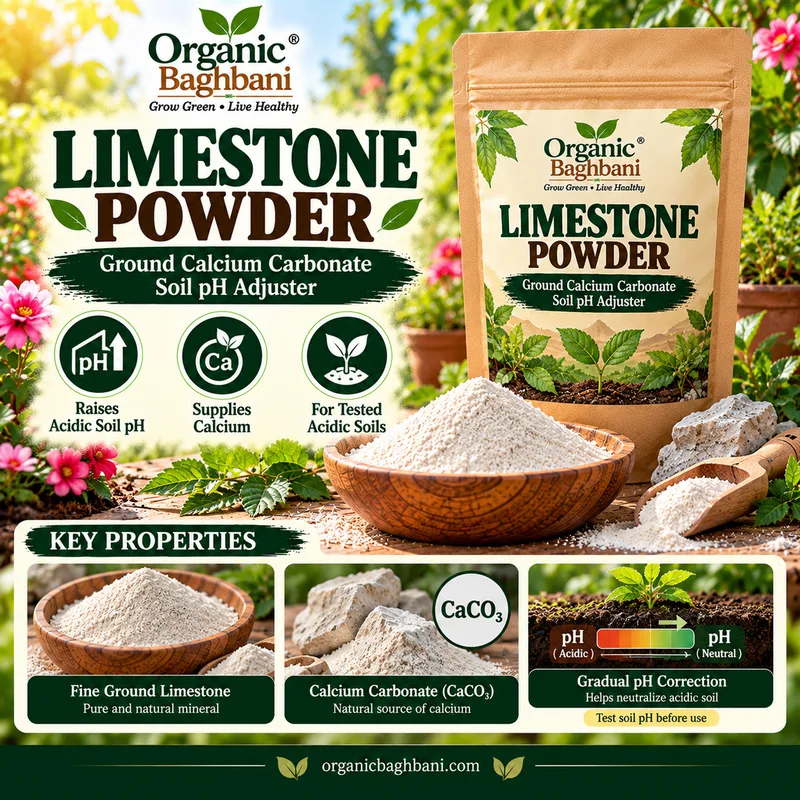
Ground limestone is a mineral soil conditioner that helps raise the pH of تیزابی مٹی (acidic soil) and adds calcium. It is not a fertiliser, not a pest spray and not for soil that is already neutral or alkaline – test first, then dose.
How Your Order Reaches You 🌿
Live step-by-step process from our store to your doorstep across Pakistan
Meaning of Limestone Powder in Urdu is “چونا پتھر کا پاؤڈر” زیادہ تر کیلشیم کاربونیٹ پر مشتمل پسا ہوا چونا پتھر، جو تیزابی مٹی کی تیزابیت کم کرنے کے کام آتا ہے. If your plants stay weak even though you water and feed them, acidic soil can be one hidden reason, and ground limestone is the classic fix.
It is a dry mineral powder made by milling limestone rock. Unlike quicklime or slaked lime, milled limestone is not burned in a kiln, so it tends to work slowly and gently rather than harshly – a good fit for gardeners who want a steady, controlled correction.
| Question | Answer |
|---|---|
| What is it? | Ground limestone, mainly calcium carbonate. A soil conditioner, not a fertiliser. |
| Product type | Soil pH adjuster for acidic soils |
| What does it do? | Helps raise the pH of acidic soil and supplies calcium. |
| Who needs it? | Beds, lawns and pots where a test shows low pH. Peat-heavy potting mixes often benefit from a small amount. |
| How much? | Starting point: about 100 g per m² in beds, 1–2 g per litre in potting mix. |
| How fast? | Slowly – typically weeks to a few months. |
| What is it not for? | Not a fertiliser, pest spray, disinfectant or whitewash. Not for alkaline soil or acid-loving plants. |
Soil turns acidic when heavy rain leaches nutrients away, when crops remove minerals season after season, and when some chemical fertilisers react in the soil. In Pakistan that can happen in wetter hill regions, in pots filled with peat-heavy mix, and in beds fed with nitrogen fertiliser for years. Does any of this sound familiar?
Each of these can have other causes too, such as overwatering, pests or uneven watering. That is why testing first matters more than buying more inputs.
The most reliable way to know whether soil is acidic or short of calcium is a soil test; labs use measures such as lime potential to judge whether lime is needed (Agriculture and Agri-Food Canada soil glossary). A pocket pH meter or test strips are a cheaper first check, and an agriculture university or provincial soil-testing lab can do a full test. Many garden soils on Pakistan’s plains tend to be neutral to alkaline, and adding lime to them can do more harm than good, so apply it only where a test shows acidity.
Searching for limestone near me? Order online from Organic Baghbani and see the full range in our Soil pH Adjusters & Conditioners category.
Results depend on your soil, your plants and your watering.
These are conservative starting points for mildly acidic soil, not a prescription. Very acidic soil needs a test-based dose, usually split into two applications several weeks apart.
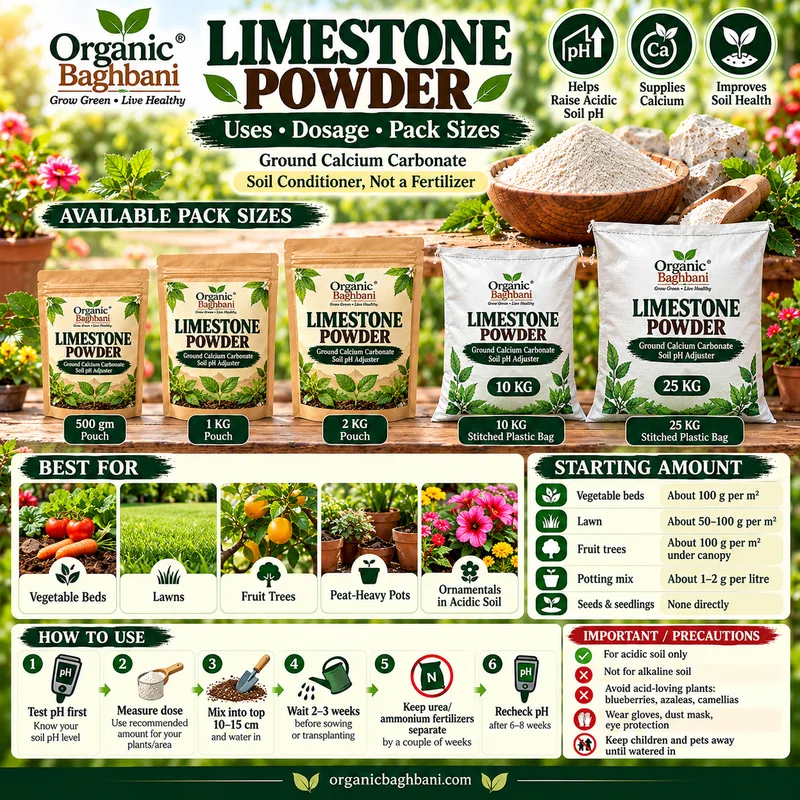
| Use | Starting amount | Notes |
|---|---|---|
| Vegetable beds | About 100 g per m² | Mix into the top 10–15 cm, 2–3 weeks before sowing or transplanting. |
| Lawn (لان) | About 50–100 g per m² | Scatter evenly, rake or brush in, then water. |
| Fruit trees (پھلدار درخت) | About 100 g per m² under the canopy | Fork in lightly and keep it off the trunk. |
| Potting mix (گملے کی مٹی) | About 1–2 g per litre (a quarter to half a level teaspoon) | Only for peat-heavy mixes or when a test shows low pH. Mix through well before planting. |
| Seeds and seedlings | None directly | Never dust powder onto seeds or seedlings. Correct the pH in the bed beforehand. |
Recheck pH after 6–8 weeks and add more only if it is still low.
Limestone changes soil chemistry; most other products feed the soil. For more choices, browse the For Acidic Soils range.
| Product | Main job | Raises pH? | Choose it when |
|---|---|---|---|
| Ground limestone (this product) | Neutralises acidity, supplies calcium | Yes | A test confirms acidic soil. |
| Organic compost | Organic matter and slow nutrition | Not a strong corrector; can gently buffer pH | pH is fine but the soil needs feeding. |
| Rice husk ash | Potassium and silica source | Mildly alkaline (about pH 8–9), so it can nudge pH up | You also want potassium; use conservative amounts. |
| Sphagnum peat moss | Light, water-holding mix ingredient | No – naturally acidic | You are building pot mixes; peat-heavy mixes are where small amounts of lime are often added. |
| Sulphur-type products | Lower pH | No – the opposite job | Soil is alkaline (not for this product). |
Rain leaching, crop removal and some nitrogen fertilisers all push soil towards acidity. Ground limestone is mainly calcium carbonate, a base that reacts with the acids in soil water, neutralising them and releasing calcium. Because soil acids are weak, particle size matters: according to Wikipedia’s agricultural lime article, finer material reacts faster, and particles much coarser than about 8 mesh do little. That is why the powder should be mixed into the soil, and why the correction builds over weeks, not overnight.
| Specification | Details |
|---|---|
| Product | Ground limestone (garden lime) |
| Brand | Organic Baghbani |
| Material | Limestone, mainly calcium carbonate |
| Form | Dry powder |
| Claim | Soil conditioner that raises the pH of acidic soil and supplies calcium |
| Primary use | Correcting acidic soil in beds, lawns, orchards and peat-heavy pots |
| Suitable for | Vegetables, lawns, fruit trees and ornamentals growing in acidic soil |
| Not ideal for | Alkaline soil; acid-loving plants such as blueberries, azaleas and camellias; direct use on seeds; pest or disease control |
| Category | Soil pH Adjusters & Conditioners › For Acidic Soils |
| Bulk orders | Special discount – WhatsApp or call 03119073909 |
| Pack Size | Effective Rate | Pack Price | Select |
|---|---|---|---|
500gm | ₨ 600 / KG | ₨ 300 | |
1kg | ₨ 499 / KG | ₨ 499 | |
2kg | ₨ 400 / KG | ₨ 800 | |
10kg | ₨ 240 / KG | ₨ 2,400 | |
25kg | ₨ 156 / KG | ₨ 3,900 |
People also search for: Limestone Powder, Limestone Powder Price in Pakistan, Best For Acidic Soils (Raise pH) for Gardening, Seed Starting & Potting Soil Mix.
At Organic Baghbani, we believe in nurturing nature the way it was meant to be. Our mission is to help Pakistani gardeners, farmers, and plant lovers grow healthier, greener plants without relying on harsh synthetic chemicals. All our organic fertilizers and soil amendments are carefully prepared to deliver maximum nutrients directly to your plants' roots.
Bring your garden back to life with 100% natural nutrition.
🌿 100% Natural & Safe: Completely free from toxic chemicals, making it safe for your family, pets, and the environment.
🌱 Improves Soil Health: Restores natural microbes in the soil, ensuring long-term fertility and explosive plant growth.
📦 Fast Nationwide Delivery: Secure and prompt shipping right to your doorstep, anywhere in Pakistan.
👨🌾 Premium Quality Guaranteed: Lab-tested and specifically suited for the harsh Pakistani climate.
No account yet?
Create an Account


Reviews
Clear filtersThere are no reviews yet.